



The Rise and Challenges of DePIN
The Rise and Challenges of DePIN: A Deep Dive into Its Prospects
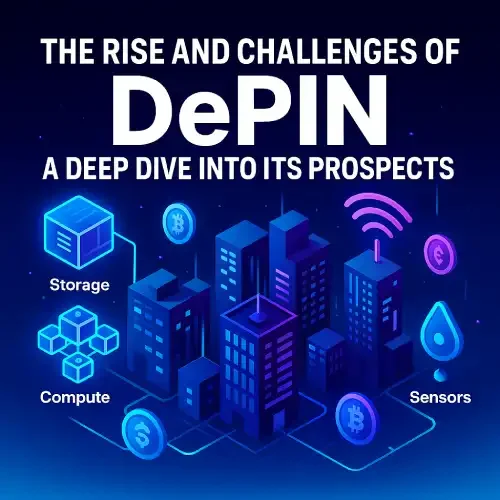
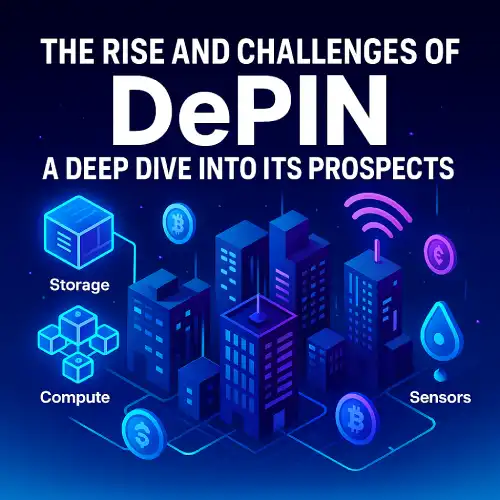
DePIN (Decentralized Physical Infrastructure Networks) uses tokens to coordinate the build-out and operation of real-world infrastructure—think connectivity, compute, storage, mapping, energy, and sensors. It promises faster deployment and better cost curves, but must overcome hardware bootstrapping, sustainable unit economics, and regulatory gray areas.
What is DePIN?
DePIN refers to networks where physical infrastructure (routers, hotspots, GPUs, EV chargers, cameras, weather sensors, delivery robots, etc.) is owned and operated by the community, not a single company. The network’s software layer (often on a blockchain) tracks contributions, usage, and rewards. Tokens become the coordination tool: they incentivize individuals to deploy devices and provide services that apps and enterprises can pay to use.
Core idea: Replace “raise capital → build centralized infra” with “reward many operators → crowd-build infra → aggregate demand.”
Why DePIN is rising now
- Cheaper hardware: Off-the-shelf radios, SBCs, and GPUs make it feasible for individuals to contribute.
- Programmable incentives: Tokens pay out automatically for measurable work (uptime, coverage, throughput, accuracy).
- Demand for edge capacity: AI, streaming, AR, and IoT want low-latency, local resources.
- Post-cloud optimization: Some workloads don’t need hyperscaler margins or centralized control.
- Community ownership narrative: Users want upside for bootstrapping networks they rely on.
Key DePIN verticals
- Connectivity: Community hotspots provide wireless coverage; devs pay for data packets.
- Compute: Distributed GPUs/CPUs serve AI inference, rendering, and batch jobs at market rates.
- Storage & Content: Redundant, geographically distributed storage and delivery.
- Mapping & Sensing: Devices gather geospatial and environmental data; buyers pay for verified datasets.
- Energy & Charging: Microgrids, solar nodes, EV chargers coordinated with dynamic pricing.
The DePIN value stack
- Physical layer: Devices, sites, power, backhaul, maintenance.
- Proof of Work(utility): Cryptographic or statistical proofs (coverage tests, job completion, data quality).
- Accounting layer: On-chain metering, payouts, slashing, and marketplaces.
- Demand layer: APIs and SDKs that let apps purchase capacity or data.
- Governance: Upgrades, economics, and dispute resolution.
Advantages
- Faster last-mile deployment: Thousands of owners install devices in parallel.
- Capex offload: The network spreads capital needs across many participants.
- Resilience: No single point of failure; multi-operator redundancy.
- Local incentives: Operators benefit directly from their neighborhoods’ usage.
- Market pricing: Open marketplaces can push prices toward real supply/demand.
Challenges
- Cold-start problem
- Issue: No one buys capacity without coverage; no one deploys without buyers.
- Mitigations: Staged rewards, anchor tenants, grants for high-value geographies, and minimum viable demand (pilot enterprise contracts).
- Proofs & Sybil resistance
- Issue: Operators may spoof coverage or jobs.
- Mitigations: Cryptographic proofs (radio triangulation, challenge-response), third-party audits, slashing, stake-weighted reputation, and hardware attestation.
- Unit economics & token design
- Issue: Rewards can outpace real revenue, causing bubble behavior.
- Mitigations: Halvings/decay, revenue-backed buybacks or burns, fee-first rewards, and using tokens mainly as access collateral rather than pure subsidies.
- Hardware lifecycle & quality control
- Issue: Device variance, firmware exploits, and maintenance logistics.
- Mitigations: Approved vendor lists, auto-updates, escrowed bounties for repairs, and community service networks.
- Regulatory & compliance
- Issue: Spectrum rules, energy permits, data privacy, labor/tax concerns.
- Mitigations: Region-specific policies, data minimization, privacy-preserving proofs, and legal entities for enterprise contracting.
- Demand aggregation
- Issue: Many DePINs build supply first but underinvest in sales/BD.
- Mitigations: Early integrations with SaaS tooling, standardized APIs, and partnerships with aggregators and marketplaces.
- Governance drift
- Issue: Voter apathy, capture by insiders, or misaligned incentives.
- Mitigations: Bicameral designs (operators vs. customers), locked voting power, and transparent KPIs.
How to evaluate a DePIN project
- Real demand today: Any paying customers? Signed pilots?
- Proof quality: Can operators fake work? How is it detected/slashed?
- Device ROI: Payback period with conservative usage; what happens as rewards decay?
- Token sinks: Fees, staking, collateral, slashing—beyond pure emissions.
- Go-to-market: API docs, SDKs, reference apps, and enterprise sales capacity.
- Compliance posture: Region coverage, spectrum/energy rules, data handling.
- Operator experience: Shipping, setup, backhaul needs, dashboards, warranty/support.
- Vendor diversity: Single supplier risk vs. commodity hardware.
KPIs that actually matter
- Active supply: Online devices with verified work (not just shipped units).
- Utilization: % of capacity sold; revenue per device/site.
- Coverage quality: Independent audits; user-perceived performance (latency, uptime).
- Revenue mix: Token incentives vs. external, fiat-denominated spend.
- Churn: Operator and customer churn; time to redeploy replacements.
- CAC/LTV: For the demand side—are paid users sticking?
- Regulatory milestones: Licenses, approvals, or clarified guidance.
Prospects: Where DePIN is likely to win first
- Niches with acute last-mile pain: Rural connectivity, edge compute for AI inference near users, and long-tail sensor data.
- Cities with innovation programs: Municipal partnerships that co-fund coverage and approve sites.
- Data markets: Where ground-truth or hyper-local data has recurring buyers (maps, mobility, weather, ESG).
- Energy & micro-infra: Community-owned solar, storage, and EV charging with usage-based payouts.
Medium-term view: DePIN succeeds when tokens stop being the only incentive. Sustainable networks convert speculative deployment into revenue-backed operations with transparent pricing, audits, and enterprise-grade SLAs.
Risks and cautions
- Speculation over service: If emissions dwarf real fees, price crashes can spook operators.
- Single-region dependence: A ban or policy change can hurt coverage overnight.
- Vendor lock-in: If one vendor controls the hardware, margins and resilience suffer.
- Security incidents: Firmware exploits or oracle failures can damage trust.
Conclusion
DePIN is a credible alternative to top-down infrastructure rollouts. Its strengths—parallel deployment, community ownership, and market pricing—are compelling, but only if proofs are robust, demand is real, and token design rewards genuine utility. The winners will look less like mining schemes and more like marketplaces for measurable real-world services.
FAQ
Is DePIN just “mining with hardware”?
No. The goal is paid, verifiable services (coverage, compute, data), not arbitrary hashing.
Do tokens guarantee ROI for device owners?
No. Returns depend on demand, proof quality, emissions, and costs. Always model conservative scenarios.
What’s the biggest hurdle today?
Reliable demand and anti-cheat mechanisms that scale across geographies and hardware types.