


Is Crypto Payment the Future?
Is Crypto Payment the Future? Pros, Cons, and How to Get Started
Why Crypto Payments Matter
- 24/7, near-instant settlement: No banking hours; transactions clear quickly.
- Borderless by default: Pay or get paid across countries without separate accounts.
- Lower fees (often): Fewer intermediaries for remittances and micro-payments.
- Programmable money: Automate payouts, revenue share, and escrow with smart contracts.
- Open ecosystem: Interoperable wallets, on/off-ramps, and DeFi services.
Best experience today: stablecoins on low-fee networks for everyday spend and B2B flows.
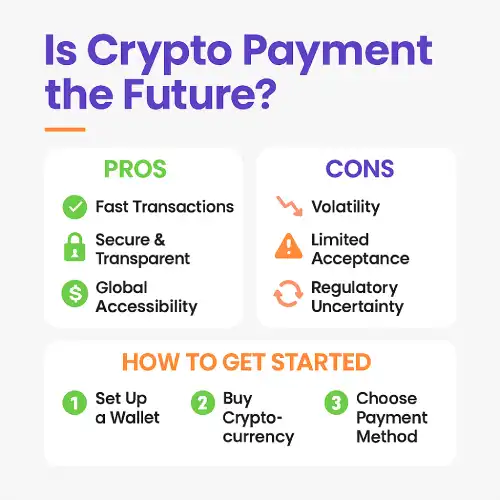
Pros & Cons at a Glance
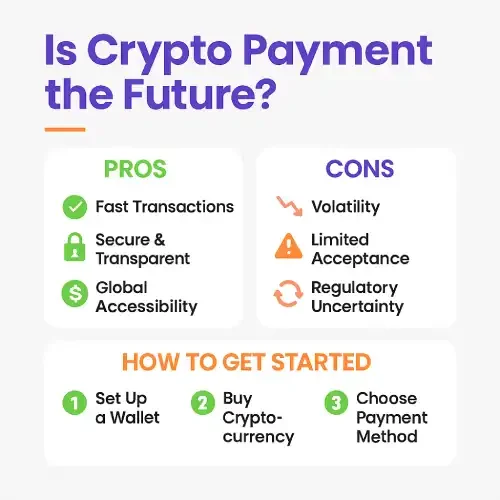
Pros
- Speed: Minutes or seconds instead of days.
- Cost: Competitive for remittances, payouts, and cross-border commerce.
- Access: Only a smartphone and internet needed.
- Control: Self-custody possible; fewer chargeback surprises.
- Innovation: Split payments, automations, and programmable invoices.
Cons
- Volatility (non-stable coins): Price swings can wipe margins—use stablecoins for payments.
- Regulatory variance: Rules differ by country; KYC/AML applies to most gateways.
- UX gaps: Recovery phrases, network choices, and gas fees can confuse beginners.
- Irreversibility: Typos and wrong addresses can’t be “undone” easily.
- Tax/accounting: Extra steps to track cost basis in some jurisdictions.
Where Crypto Payments Shine
- Remittances & global payroll: Send faster with stablecoins; recipients cash out locally.
- B2B cross-border invoices: Reduce wire delays and minimize FX slippage.
- Creator & gig economy payouts: Micro-earnings and instant settlement.
- E-commerce & subscriptions: Card alternatives for regions with low card penetration.
- Nonprofit & community funds: Transparent treasuries and auditable disbursements.
Myths vs Reality
- “Crypto is only for speculation.”
Reality: Stablecoins are built for spending and settlement, not price bets. - “Fees are always high.”
Reality: Choose the right network (e.g., low-fee L2s) and fees can be cents. - “It’s anonymous.”
Reality: Most flows are pseudo-anonymous and traceable; compliance still applies. - “Merchants must hold volatile assets.”
Reality: You can auto-convert to stablecoins or fiat at acceptance.
How to Get Started
- Pick a trusted wallet (mobile app with clear recovery and biometrics).
- Use stablecoins for daily payments (reduce volatility).
- Fund safely: test with a small amount first (P2P, exchange, or on-ramp).
- Security basics: enable passcode/biometrics + 2FA, and back up recovery credentials securely.
- Practice a test payment (scan a QR / send to a known contact).
- Cash-out plan: know your local off-ramp or card route in advance.
How to Start Accepting Crypto
- Choose a gateway (custodial or non-custodial) that supports stablecoins and your region.
- Decide settlement: keep funds in stablecoins or auto-convert to local currency.
- Integrate checkout: hosted page, plugins (Shopify/Woo), or API for custom flows.
- Price display: show totals in local currency; the gateway handles conversion.
- Accounting & tax: pull reports from your gateway; tag transactions by order ID.
- Fraud & refunds: set clear refund policies; consider using escrow for high-value orders.
Picking Networks & Fees
- Prefer low-fee chains/L2s supported by your wallet and on/off-ramp.
- Avoid bridging unless needed; each hop adds delay and risk.
- Batch payouts to save fees; schedule during low-congestion windows.
Safety & Compliance Checklist
- Use whitelists and saved recipients for repeat payments.
- For businesses, complete KYC/KYB and configure team roles/approvals.
- Turn on alerts for large or unusual transactions.
- Keep clean records for audits and refunds.
- Educate staff on phishing and address-confirmation steps.
FAQs
Are crypto payments legal?
Usually permitted with conditions; specifics vary by country. Use compliant gateways and follow KYC/AML rules.
Which crypto is best for paying?
Stablecoins (e.g., USD-pegged) on low-fee networks are most practical.
Can I reverse a crypto payment?
On-chain transfers are final; refunds must be sent as a new transaction.
Do I need a bank account?
Not to hold or send crypto, but many off-ramps and gateways require linked bank details for fiat settlement.
What about chargebacks?
On-chain payments don’t have card-style chargebacks; set clear refund policies and use escrow for higher risk orders.